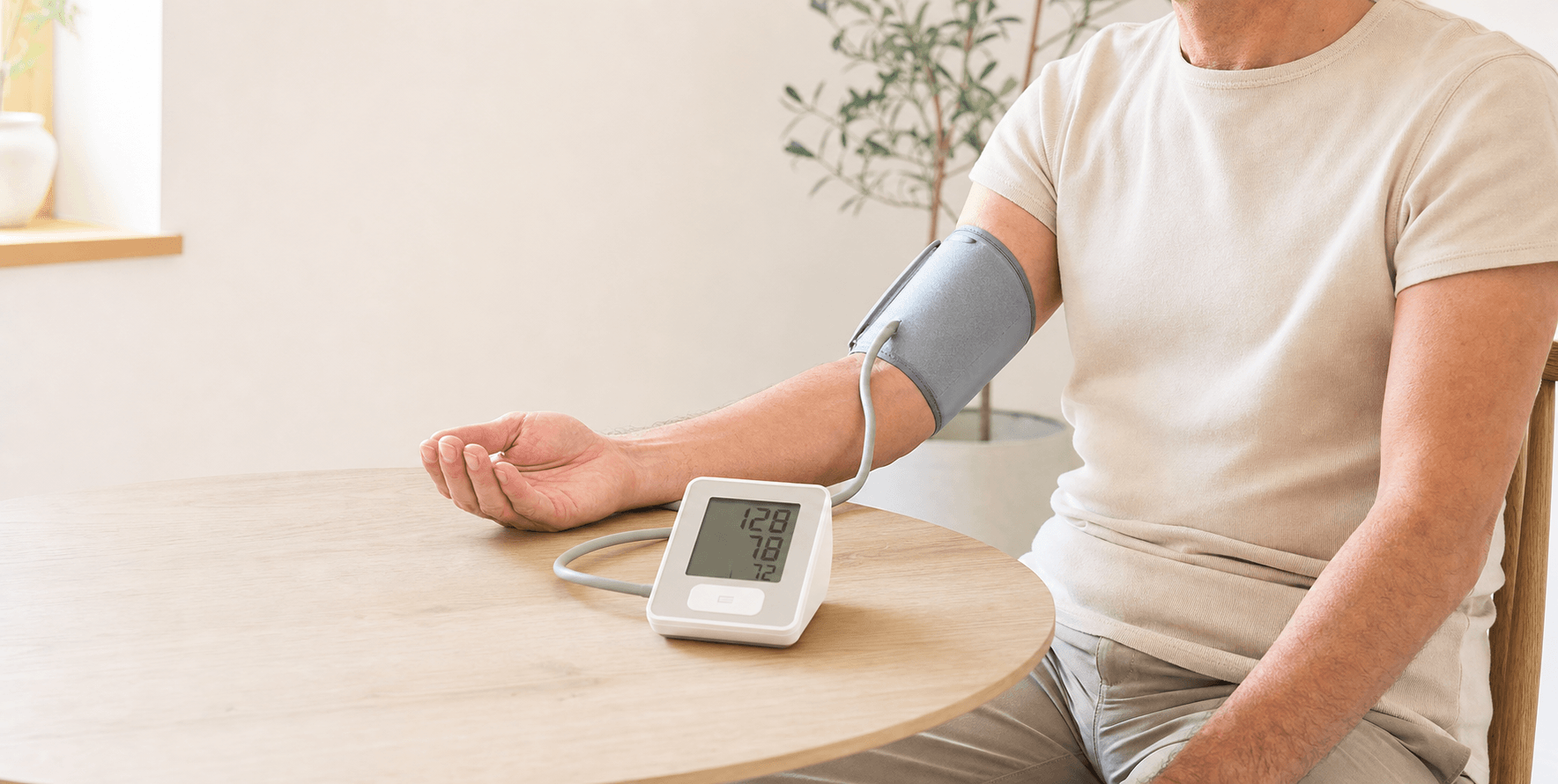
Measuring blood pressure at home can show what is happening in everyday life, outside of the doctor's office environment. But to be of value, it requires proper technique and repeated measurements — not constant checking every time there is stress or discomfort.
At a glance
The main points
- Use a certified upper arm sphygmomanometer with the correct cuff size.
- Sit quietly for five minutes before the measurement.
- Take two readings a short time apart and record both.
- Do not change treatment yourself based on a single price.
The right blood pressure monitor and the right cuff
An automatic, clinically validated upper-arm blood pressure monitor is preferred. Wrist monitors are more sensitive to arm position and are usually not the first choice. The cuff must fit the circumference of your upper arm; a cuff that is too small or too large can give misleading readings.
It is worth bringing the device to one visit so that fit and technique can be checked and compared to the doctor's measurement.
What to do before the measurement
For about thirty minutes, avoid smoking, coffee, energy drinks and vigorous exercise. Empty your bladder and sit quietly for five minutes without talking or using your cell phone.
Take readings at fairly consistent times when following a monitoring plan. A reading taken immediately after climbing stairs, stress or pain reflects that moment and does not represent your resting blood pressure.
Body position step by step
Sit in a chair with your back supported, feet flat on the floor and legs uncrossed. The arm should rest at about heart level and the cuff should rest on bare skin, not over clothing.
- Do not talk or move while the device is operating.
- Both hands may be measured in the initial assessment.
- For systematic recording use the indicated hand.
- Wait about one minute before the second measurement.
A handy measurement diary
When the doctor asks for a record, an organized set of morning and evening readings for certain days is often more useful than dozens of random readings. Note time, systolic and diastolic blood pressure, pulse and any unusual condition.
Don't hide high values and don't just keep the lowest one. The average and pattern are usually more useful than the "best" number.
Common mistakes that affect readings
Measuring over a sleeve, short cuff, unsupported hand, talking, crossed legs and repetitions without pause can alter the result. Also, measuring too frequently due to stress can create a vicious cycle of worry and transiently higher values.
An irregular heart rhythm can make it harder for some automatic monitors to measure accurately. If readings vary widely or an irregular-heartbeat symbol appears frequently, discuss this with a doctor rather than diagnosing yourself.
How values are interpreted
The diagnosis of hypertension is not usually based on a single measurement. Repeat in-office or out-of-office measurements, overall history, and potential organ damage are evaluated. In some cases, a 24-hour blood pressure recording is needed.
Treatment goals are not the same for everyone. Age, tolerability, other conditions and overall risk factor into the decision. Do not skip or double medication without specific medical direction.
When not to wait
Immediate medical attention
If a very high reading is accompanied by chest pain, severe shortness of breath, confusion, weakness or numbness, speech or vision disorder, seek immediate medical help via 112 or 166. Do not wait for a response from a form or email.
Sources & further reading
The article provides general information and is not a substitute for an individualized medical evaluation.