Committed to Care
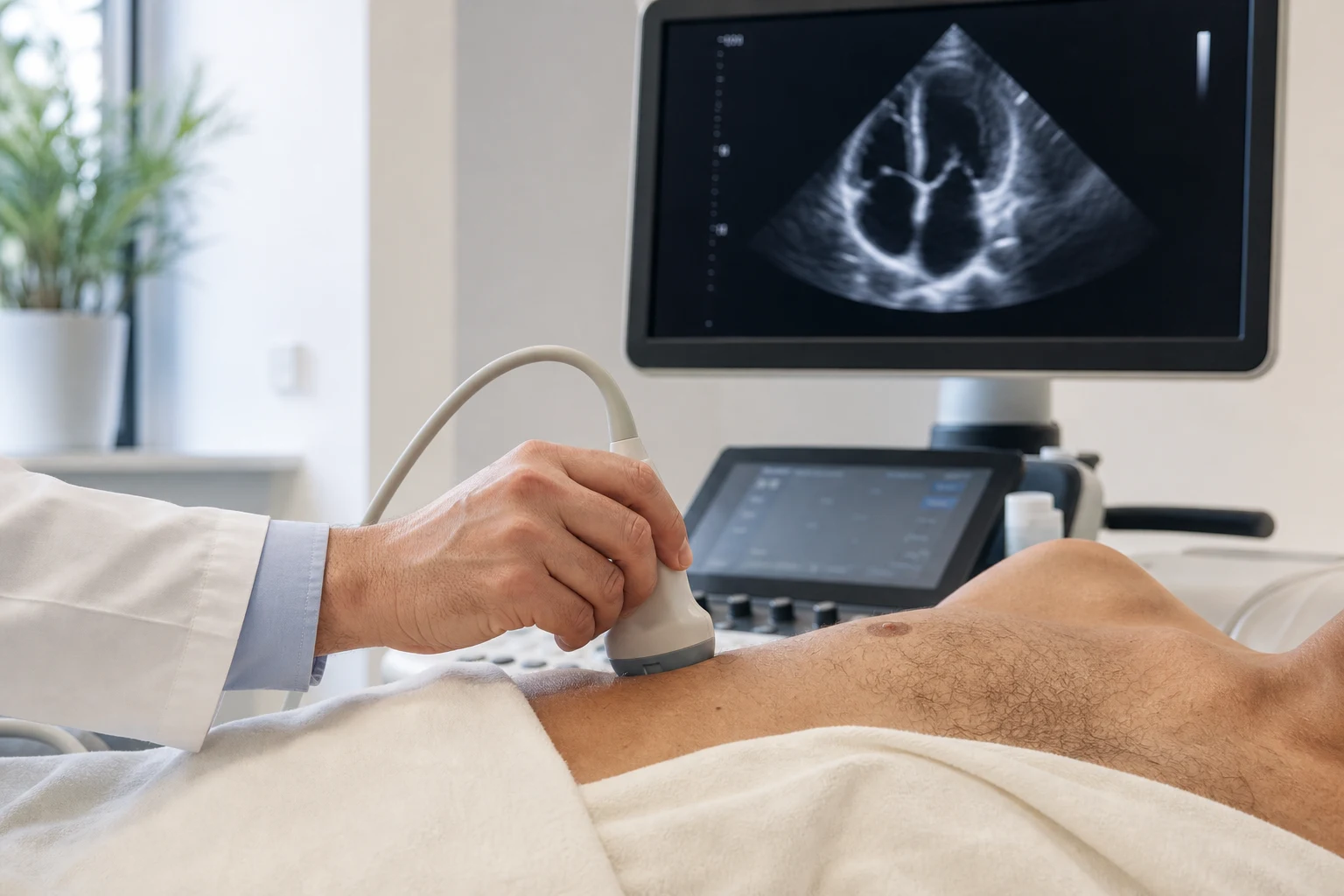
Cardiology services
Echocardiogram
Heart ultrasound allows live study of the chambers, valves and contractility of the heart.
At a glance
PurposeTo assess the structure and function of the heart, valves and blood flow.
DurationUsually 20–30 minutes, depending on the clinical question and findings.
PreparationNo.
Returning to daily activitiesImmediately.
When results are availableFindings are available immediately and explained after the exam is complete.
The heart in real time
Image of the structure. Measurement of function.
Echocardiogram uses ultrasound to show the chambers, valves, myocardial movement and blood flow live.
Its value is not found in just one measurement. The cardiologist combines multiple acquisitions and Doppler parameters with the clinical picture, so that the finding acquires a correct meaning.
Heart chambers
Dimensions, wall thickness and morphology of the heart.
Contraction
Assessment of myocardial motility and pumping capacity.
Valves & Flows
Doppler study of valve movement and blood flow.
The process
Painless examination, many angles of information.
The examination is performed in a calm environment, usually with the examinee in the left lateral position. It does not use ionizing radiation.
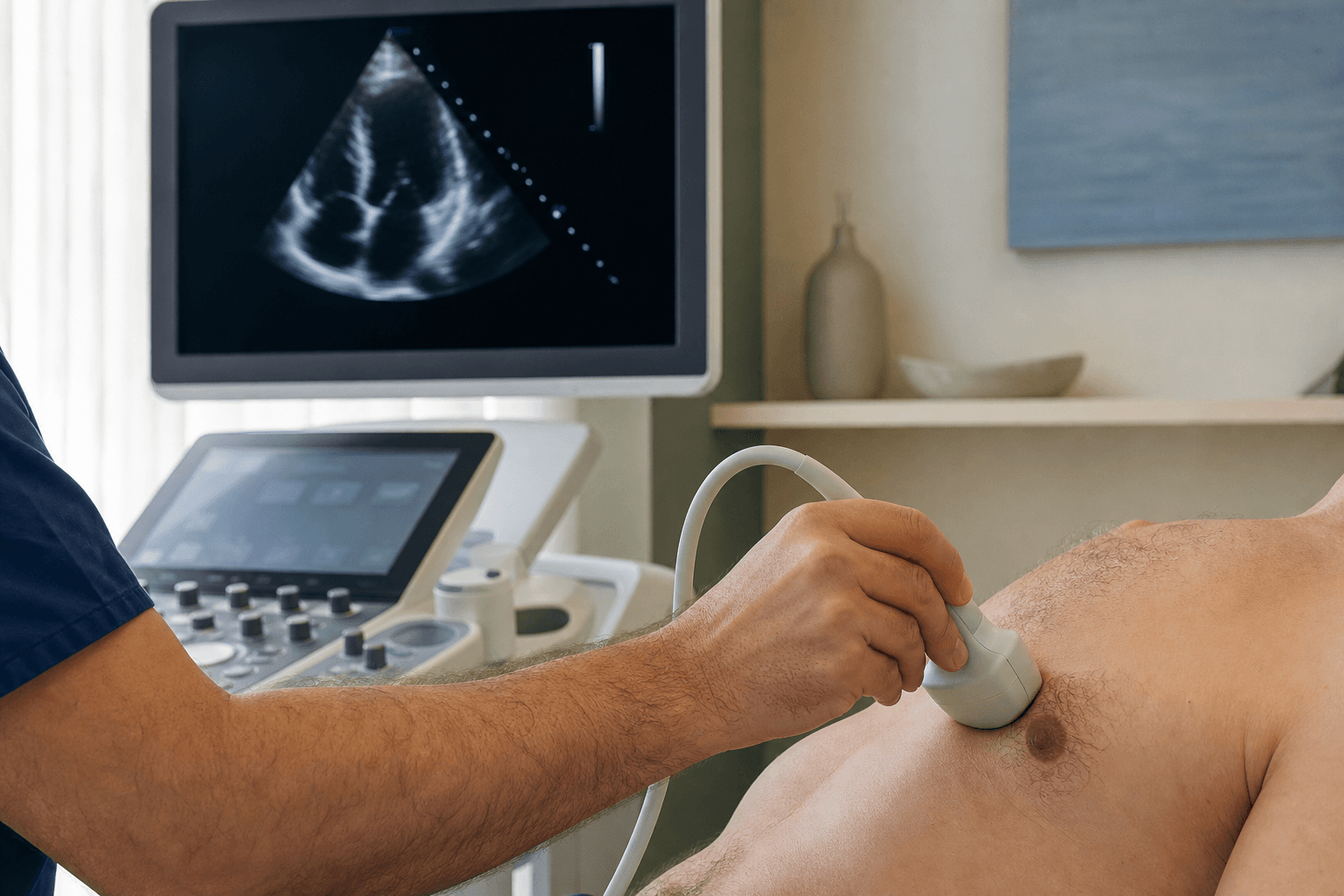 Ultrasound — no radiation
01
Placement
Electrodes are placed for synchronization and a small amount of gel is placed on the chest for clear transmission of the ultrasound.
02
Downloads and Doppler
The ultrasound probe is moved to specific positions to record the heart’s anatomy, movement and blood flow.
03
Synthesis of findings
Images and measurements are evaluated together, in relation to the reason for which the examination was requested.
The picture needs a clinical context
A finding is not a diagnosis by itself.
Small deviations may not have the same meaning for every person. Interpretation depends on age, body type, symptoms, blood pressure and previous tests.
Common indications
When we need to see what the heart looks like and how it works.
Heart murmur
To investigate the function and morphology of the valves.
Hypertension
To assess possible effects of blood pressure on heart muscle.
Shortness of breath or swelling
In the context of investigating cardiac structure and function.
Monitoring
For comparison of known valvular disease, cardiomyopathy or other finding.
Before, during, after
A simple preparation helps the correct comparison.
Before
Fasting is usually not required. Bring previous ultrasounds and relevant reports.
During the examination
You may be asked to change position or hold your breath for clearer shots.
After
There is no recovery time. The key findings are part of the overall cardiological evaluation.
Frequently asked questions
Practical answers before your examination.
01
Does the Echocardiogram have radiation?
No. It uses ultrasound and involves no ionising radiation.
02
Is fasting necessary?
Usually not for a standard transthoracic echocardiogram. If it is combined with another test that requires special preparation, you will receive instructions when booking.
03
How often should the test be repeated?
Only when there is a clinical reason and in the interval corresponding to the specific finding. The frequency is not the same for everyone.
The right test for the right question
Do you need this exam?
The indication and preparation are determined individually by the cardiologist.
Helpful answers
What you need to know.
01
When is it needed?
When there are symptoms or findings that need investigation, in known heart disease or when it is deemed necessary in the cardiac check-up.
02
What information does it give us?
It shows the structure and function of the heart, the dimensions of the chambers, the contraction and function of the valves.